My Books

  • John Donne (my best)
  • Shakespeare
  • Anything by Terry Pratchett
  • Lord of the Rings
  • The Little White Horse
  • Wind in the Willows
  • Secret Garden
Showing posts with label Islam. Show all posts

Wednesday, 21 July 2010

Politics and Poetry

The 14th Dalai Lama, a renowned Tibetan Buddhi...Image via Wikipedia
I would argue that the most powerful weapon man has is his ability to craft words. They can win wars in ways that guns cannot; they can move the most obstinate of believers to take a new stance.


The Dalai Lama knows this: for years he has used words to wage his battle against his aggressors. If he was not succeeding one has to wonder why China find it necessary to censor his words, his images and those of his followers. Jihad is a word - holy war. To some it is a call to heaven to others the knell of a death bell.
In Alice in Wonderland Tweedledum said that he could make words mean whatever he wanted them to. Post modernist criticism has taken that view to the point where words themselves cease to have any real resonance because they can be proven to mean so much and so little.


We argue about the Bible, the Koran, the words of this prophet and that. And then we take up guns, and tanks, and planes, and bombs and land mines and we no longer bother to speak for who would listen? The words that are understood now are finance, economy, globalisation. Where in those dialogues is there a place for the poor, the lost, the starving and the dispossessed. William Hague said that a dialogue with China was necessary for the global market. Then he mentioned the rather bad reputation China had on human rights in Tibet. They occupied a country - committed genocide and mass repopulation - attempted to destroy a culture unchanged for centuries. These are the words that should have been used, along with the statement that there is no place in our global economy for those who take greedily what is not theirs.

So words can matter, can be powerful. Look at the great figures of history and how they used words to move people to impossible achievements. "I have a dream", "Ask not what your country can do for you but what you can do for your country", "Forgive us our sins as we forgive others",  " We will fight them on the beaches..." and so many more. Words that made a difference to our lives today.

We all have voices, we use them to swear, and call out and talk of trivia but how often do you or I  use them to make a difference. Let's start. Let's use the example of the Dalai Lama, and speak for change, ask for change  and make ourselves heard. Ten voices can be heard across a field. Ten thousand  more   heard across continents and seas. If something is wrong say so! Say it again and again until you are heard.

A poet that I love, went for a walk one night and came home and wrote this


THE WORLD.
by Henry Vaughan
 I SAW Eternity the other night,
Like a great ring of pure and endless light,
              All calm, as it was bright ;
And round beneath it, Time in hours, days, years
                      Driv'n by the spheres                                    5
Like a vast shadow mov'd ; in which the world
                      And all her train were hurl'd.
The doting lover in his quaintest strain
                      Did there complain ;
Near him, his lute, his fancy, and his flights,                         10
                      Wit's sour delights ;
With gloves, and knots, the silly snares of pleasure,
                      Yet his dear treasure,
All scatter'd lay, while he his eyes did pour
                      Upon a flow'r.                                             15


2.                
The darksome statesman, hung with weights and woe,
Like a thick midnight-fog, mov'd there so slow,
              He did nor stay, nor go ;
Condemning thoughts—like sad eclipses—scowl
                      Upon his soul,                                                  20
And clouds of crying witnesses without
              Pursued him with one shout.
Yet digg'd the mole, and lest his ways be found,
                      Work'd under ground,
Where he did clutch his prey ; but one did see                     25
                      That policy :
Churches and altars fed him ; perjuries
                      Were gnats and flies ;
It rain'd about him blood and tears, but he
                      Drank them as free.                                    30


3.                
The fearful miser on a heap of rust
Sate pining all his life there, did scarce trust
              His own hands with the dust,
Yet would not place one piece above, but lives
                      In fear of thieves.                                        30
Thousands there were as frantic as himself,
              And hugg'd each one his pelf ;*
The downright epicure plac'd heav'n in sense,
                      And scorn'd pretence ;
While others, slipp'd into a wide excess                               35
                      Said little less ;
The weaker sort slight, trivial wares enslave,
                      Who think them brave ;
And poor, despisèd Truth sate counting by
                      Their victory.                                              40


4.                
Yet some, who all this while did weep and sing,
And sing, and weep, soar'd up into the ring ;
              But most would use no wing.
O fools—said I—thus to prefer dark night
                      Before true light !                                        45
To live in grots and caves, and hate the day
              Because it shows the way ;
The way, which from this dead and dark abode
                      Leads up to God ;
A way where you might tread the sun, and be                     50
                      More bright than he !
But as I did their madness so discuss,
                      One whisper'd thus,
“This ring the Bridegroom did for none provide,
                      But for His bride.”                                      55


JOHN, CAP. 2. VER. 16, 17.                 
    All that is in the world, the lust of the flesh, the
lust of the eyes, and the pride of life, is not of the
Father, but is of the world.
    And the world passeth away, and the lusts thereof ;
but he that doeth the will of God abideth for ever.        60


[* Money (AJ Note)]


Source:
Vaughan, Henry. The Poems of Henry Vaughan, Silurist
E. K. Chambers, Ed. London, Lawrence & Bullen Ltd., 1896. 150-152.


This he wrote in the late seventeenth century when such an image was unimaginable - yet here it is. Eternity. You see words do have power to move and inspire and to make us dream of impossibilities.



Enhanced by Zemanta

Friday, 9 July 2010

Being a small baba in a big world

Kolkata, child labour in Dum DumImage by sharon.schneider via Flickr
I was lucky enough to have an unbelievably privileged life in my childhood and teens and because my mother, as you have probably guessed by now, had some unique views on parenting I saw and did many things that many other children never had the chance to do.


My parents went to Calcutta when I was three and a half and I think one of my earliest memories was the drive from Dum Dum to Ballygunge after a flight of nearly twenty four hours +. Impossible to believe now but we were in Karachi for seven hours while the crew changed. This may be me seeing the past with a fond and nostalgic eye but ... I maintain that I looked out of the window of my fathers little Fiat with eyes of wonder that only a child can have. I didn't see dirt or poverty - I saw Life, rickshaws and bullocks and pi dogs. People moving, colours, the indefinable smell and the heat making the road shimmer like a silver ribbon in front of us.


I was utterly spoiled - I had Mary, my ayah and Joe who was our bearer, part Burmese because his grandmother had come from Burma as an amah to Governor General's wife. I don't which one. Mary just loved me and I adored her and Joe was my best friend. He taught me how to make beds, used to show me 'masmarojan' (don't know, don't ask) which involved magical coins appearing from ears and always being able to find my bear when I lost him. I  must have been absolute nightmare for them; I decided after the first day of school that education was not for me! Told them both I was very ill, just four now but already a drama queen, and if they made me go school I would die and mummy would blame them and they would be very sorry. Of course they didn't send me and when my mother got home they were terrified. I had,  of course, recovered by then. she thought it was funny but made me apologise to both of them and buy them each a present with my pocket money. I had the day off school to do that. And I learned such an important lesson - nobody has the right to make people scared because they feel they have some sort of power - ever!


I think my mother must have been bored, this was pre-Desmond and the mountains and long before she took to racing. She was quite lonely and in 1959 Calcutta still had a very strong hierarchy of memsahibs. Dr. Handel's wife Lisl, my father's employer, took Mum shopping. She was told she was a chota memsahib and could only buy her clothes and or materials  from certain places. Burra memsahibs went elsewhere. Not easy - and she didn't want to go to the British Women's Club: she would say why have I come to India to go there? I didn't like those women in England and they are much worse here.


So we explored- Mum and me, we walked and we went in rickshaws. We paddled through the floods in the monsoon and curled up in the one air conditioned bedroom we had when it was hot. She took me to Kali ghat at 4, to the Jain temple, to the mosque and reluctantly let me go to Sunday School at Bishop's College. I wanted the stickers of the pretty people. When I came home with one that said sinners will be damned Sunday School  became a distant memory. She wanted me to have my own thoughts, ideas and beliefs and she knew that that could only come from experiencing as much as possible of many ways of belief and of living.


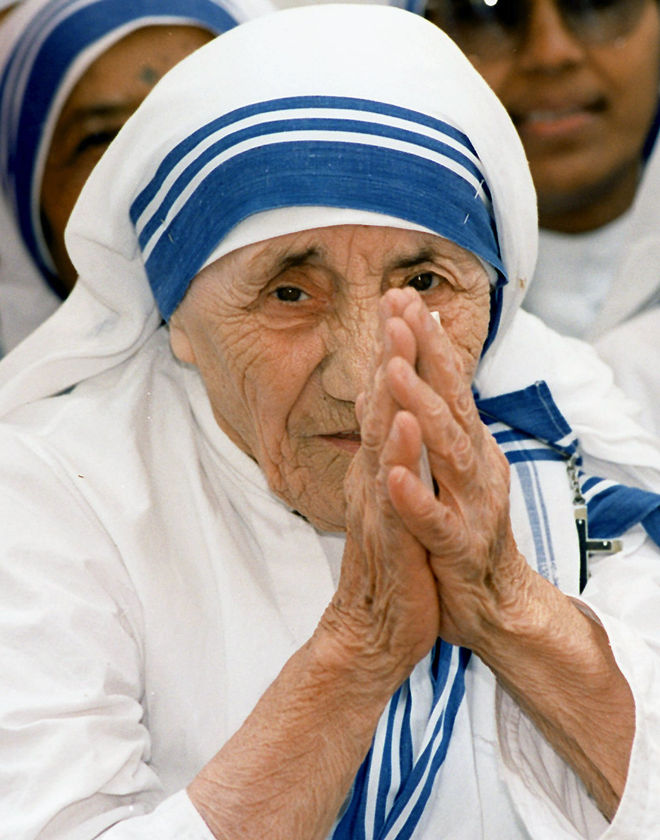
Combine that with the fact the Dad was Mother Theresa's doctor for many years and I was taken at 5 to the Kali ghat again but this time to see the nuns working with the dying. I have no vivid memory of this which is odd because it must have been quite traumatic for a child, but then maybe the clear sight of a child saw only the good and did not understand death and dying. When I was older I worked for a time with the children and that was hard, there were too many and they were needed so much love that there simply wasn't time to give them. In my teens I helped out the male Missionaries of Charity, Brother Andrew as close to a saint as any, realising that there was need to something for those who used drugs or drank. And that time has stayed with me always.


So OK that was the character building stuff. Sadly school remained mandatory and it wasn't until I was 13 that I saw a glimmer of light at the American School, AISC. My seventh grade teacher and eighth was Miss Jagtiani - I still don't know her first name but she taught us Bharatnatyam and about Martin Luther King and read to us from an obscure Italian book, 'Don Camillo' which I loved and love to this day. She gave me The Lord of the Rings and, when I finished it, free range of the library to read whatever I wanted. I did: Freud, Aristotle, Plato, the Mahabharata and the Ramayana. She would tell us the stories of Krishna and the milkmaids and she could not help but dance as she did and her hair would fall out of its bun and stream down her back as she moved faster and faster and we were there watching the Lord Krishna meet Radha, their love growing. She was absolute magic and I wish I could tell her now - she was the only one ever to reach this underachieving, school hating child.


On Saturday, as I grew older, my parents went to the races at RCTC. I was too young to go so was sent with Mary and George the driver to watch the 1400 metre start. I was 14 before I realised that a horse race was about more than simply riding them out of  a starting gate - OK I am exaggerating but it was a long time! 


After the excitement of seeing jockeys with their (pert) little bottoms in the air Mary and I would go to the pictures. Unfortunately the only English film that was on and a U was the Sound of Music. I saw it 14 times - Mary cracked after 7 and begged not to go again so my  mate Abdul was allowed to accompany me. Abdul's grandfather was a market boy at the New Market. Yes, I know, 60 if he was a day and still a boy! He wanted more for his grandson so Mum said okay he can come and learn to be a bearer. He was two or three years older than me and he was my friend. We would talk for hours about 'fillums' specially when I started to go and watch the Hindi ones. He would sing all the latest songs he had heard  and learned. From knowing him I appreciated the power of film in a country where so many  had so little and so few had so  much. For Abdul it was his escape - for a couple of hours he was Dev Anand, Shashi Kapoor or Amitabh. He got the girl, won the fight and escaped reality. 


I'm going on too much. I feel like Evita, 'have I said too much?'


Don't cry for me; I am lucky. I saw all this but  did not have to live it as Abdul and Old  Buddha (his grandfather) did. I got on a plane  and flew away But I'll tell you this, that little girl driving  in from the airport, knew home when she saw  it and left her heart there forever.


Enhanced by Zemanta